
Facts & Figures
|
Number of Volumes |
24 |
|
Number of Issues |
47 |
|
Number of Articles |
634 |
|
Article View |
977031 |
|
View Per Article |
1541.06 |
|
PDF Download Per Article |
1153.19 |
|
Number of Submissions |
2,409 |
|
Accepted Submissions |
634 |
|
Acceptance Rate |
26 |
|
Time to Accept (Days) |
180 |
|
Number of Indexing Databases |
13 |
|
h.index |
24 |
|
Average time efficiency of the judging process |
48 |
Note: The cost of publishing an article in the Journal of Clinical Psychology and Personality is one million Rials (one hundred thousand Tomans).
|
Clinical Psychology and Personality |
Title of the publication: |
|
Bi-quarterly magazine (2 issues per year) |
Release sequence: |
|
September 2003 |
Release date: |
|
Electronic |
Publication type: |
|
Persian with English Abstract |
Publication language |
|
2345-4784 |
Electronic ISSN: |
|
From September 2003 to February 2011, it was published under the title "Behavior Scholar" and in the form of a bi-monthly journal (explanation that the journal of Behavior Scholar was published as a bi-monthly journal, but only 2 of its 6 issues per year belonged to articles in the field of clinical psychology and personality. Therefore, after the separation of the specialized journal "Clinical Psychology and Personality" from Behavior Scholar, only these two relevant issues are included in the archive from 2003 to 2011.)
- From April 2019 onwards, published under the title "Clinical Psychology and Personality" and in the form of a bi-quarterly magazine.
* From May 22, 2001, to February 20, 2019, has a scientific-research accreditation from the Scientific Publications Commission of the Ministry of Science, Research and Technology. * The journal is licensed by the Ministry of Islamic Guidance with number 70345 dated 26/12/2016. * This publication has a Q2 rating and an impact factor of 0.533 in the ISC database. * Also, based on the ranking results of the Publications Commission of the Ministry of Science, Research and Technology in 2019, 2020, and 2021, this publication has been ranked "B". in 2022 , 2023 and 2024 has been ranked A View the certificate of scientific research rank of 2019 View the certificate of scientific research rank of 2020 View the certificate of scientific research rank of 2021 View the certificate of scientific research rank of 2022 |
changes and The validity and scientific rank of the journal: |
|
Research Article |
Type of possible articles to be published: |
|
Shahed University |
Concessionaire and publisher: |
|
Dr. Rasool Roshan Chesli |
Responsible manager and editor |
|
Journal of Clinical Psychology and Personality is a scientific journal with open access. The full text of the articles is available in PDF format on the journal's website and visitors can download it for free. |
Full-text format of articles: |
|
Open Access |
Access the full text of articles: |
|
Peer-Review and Double Blind |
Type of article review: |
|
In order to protect the rights and intellectual and intellectual property of researchers and authors of scientific articles and prevent duplicate research, the journal uses the software of the Irandoc search system (Hamanandjoo). |
Articles plagiarism software: |
|
http://cpap.shahed.ac.ir |
Publication website: |
|
cpap@shahed.ac.ir |
E-mail: |
|
Respecting the rules of ethics in publications, this publication is subject to the rules of the Committee on Ethics in Publication (COPE) and follows the executive regulations of the law on preventing and dealing with fraud in scientific works. |
Ethical principles of the journal: |
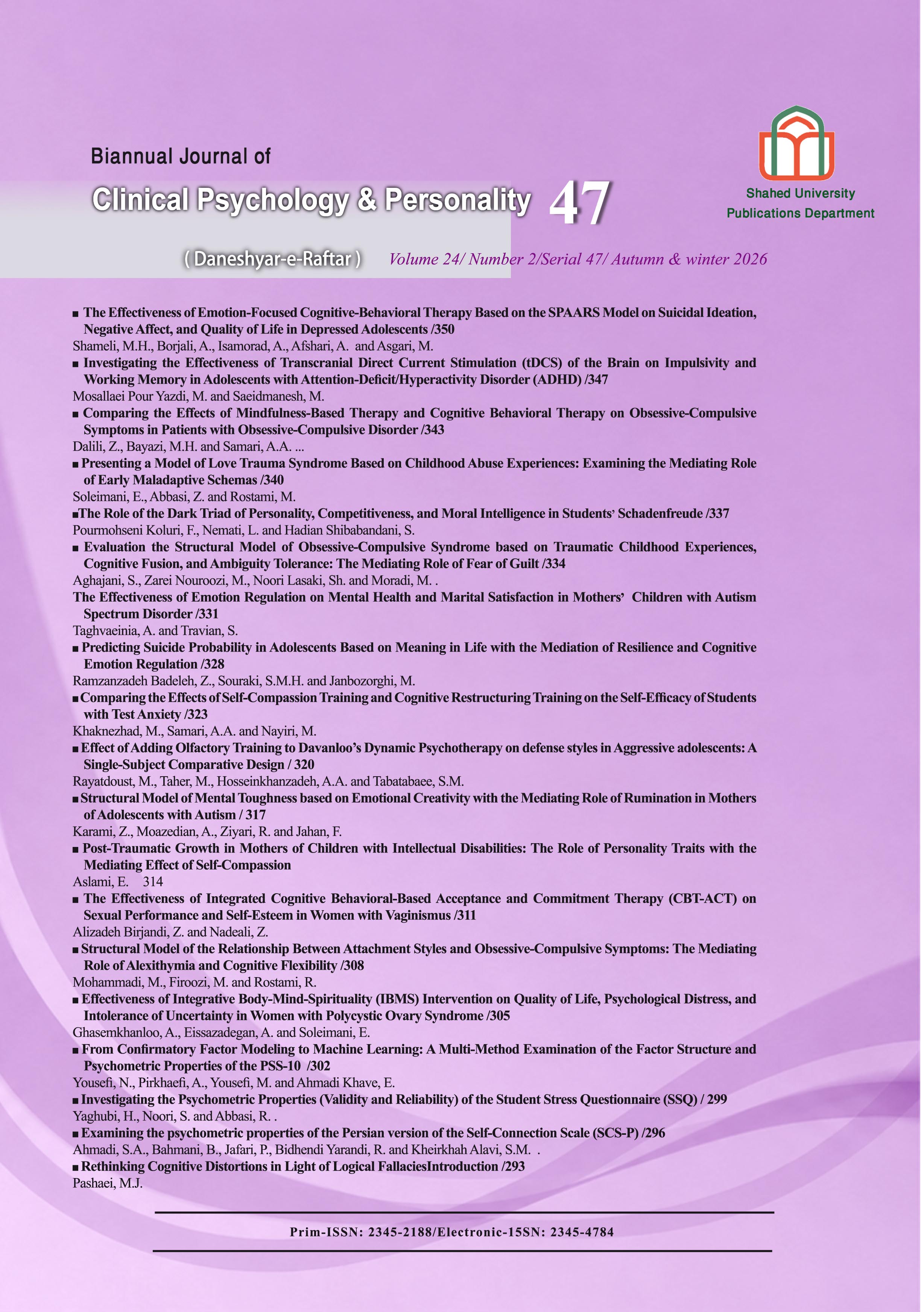
Pages 1-16
Mohamad Hasan Shameli, Ahmad Borjali, Abolghasem Isamorad, Afrooz Afshari, Mohamad Asgari
Pages 17-30
Mina Mosallaei pour Yazdi, Mohsen Saeidmanesh
Pages 31-44
Zahra Dalili, Mohammad Hossein Bayazi, Ali Akbar Samari
Pages 45-60
Esmaiel Soleimani, Zahra Abbasi, Mohammad Rostami
Pages 61-72
Fereshte Pour Mohseni Koluri, Latife Nemati, Sahel Hadian Shibabandani
Pages 73-90
Seyfollah Aghajani, Mohammad Zarei Nouroozi, Shayan Noori Lasaki, Mohadese Moradi
Pages 91-104
Ali Taghvaei nia, Sara Taravian
Pages 105-122
Zahra Ramzanzadeh Badeleh, Seyyed Mohammad Hoseini Souraki, Masood Janbozorgi
Pages 123-136
mohammad khaknezhad, Ali Akbar Samari, Mehdi Nayiri
Pages 137-152
Masoud Rayatdoust, Mahboobe Taher, Abbas Ali Hossein Khanzadeh, Seyed Mosa Tabatabaee
Pages 153-168
Zohreh Karami, Ameneh Moazedian, Reza Ziyari, Faezeh Jahan
Pages 169-184
Elahe Aslami
Pages 185-198
Zahra Alizadeh Birjandi, Zohre Nadeali
Pages 199-214
Mahsa Mohammadi, Manijeh Firoozi, reza rostami
Pages 215-226
Arzoo Ghasemkhanloo, Ali Esazadegan, esmaiel soleimani
Pages 227-250
Noorellah Yousefi, Alireza Pirkhaefi, Marzieh Yousefi, Ehsan Ahmadi Khaveh
Pages 251-262
Hamid Yaghubi, Samane Nouri, Rohollah Abbasi
Pages 263-278
Sayed Amirhossein Ahmadi, Bahman Bahmani, Parvin Jafari, Raziyeh Bidhendi Yarandi, Seyed Mohsen Kheirkhah Alavi
Pages 279-292
Mohammadjavad Pashaei


